Most people assume difficult conversations are costly. They worry about hurt feelings, damaged relationships, retaliation, conflict, and looking bad for getting it wrong. So they avoid the conversations and hope everything will work out on its own. You know better. Hope is not a strategy.
Avoidance rarely saves us from the experiences we fear. More often, it allows them to grow into something worse.
What is the most expensive conversation you’ve never had?
As an employment attorney, mediator, and former human resources supervisor, I’ve seen this pattern repeatedly. A concern goes unaddressed. A misunderstanding is left to fester. A team member remains silent about a problem. A leader avoids giving feedback. A colleague hesitates to ask a clarifying question.
What begins as discomfort can evolve into distrust, disengagement, turnover, grievances, complaints, lawsuits, and other consequences that are far more costly than the original conversation. That’s why I continue to train clients and their employees to build their conflict resolution skills, starting with having difficult conversations effectively.
Listen with your third ear for the hurts you can heal.
Conflict Doesn’t Disappear When We Ignore It
Many people think that if they don’t address a conflict, it will eventually resolve itself. Occasionally, that’s true, but often, it is not. More commonly, unresolved issues become larger conflicts because our brains like complete stories and fill in the gaps. Assumptions and theories replace facts. Others become involved, even though they were never part of the original concern. Regardless of whether they agree with our version of the situation, frustration grows.
Conflict is not necessarily the problem. Unaddressed conflict is.
The energy we spend avoiding a conversation can eventually exceed the energy that would have been required to have it in the first place. In other words:
Unaddressed conflict earns compound interest. ~ Dr. Gerald M. Weinberg
Silence Can Undermine Psychological Safety
One of the most significant costs of avoidance is its impact on psychological safety. This does not mean you will have a workplace without disagreements. Instead, the people in your organization will trust that they can raise concerns, ask questions, challenge ideas, admit mistakes, and share perspectives without fear of humiliation or retaliation.
When concerns consistently go unaddressed, people notice and that trust is broken. Employees stop sharing ideas and withhold feedback. As a result, leaders are less informed about problems that require attention. What appears to be peace might just be silence, and that is not always a sign of agreement. When I was the Main Representative to the United Nations for a non-governmental organization (NGO), we often said:
The absence of war is not necessarily peace.
We have to look deeper, listen to and solve the real problems that affect day-to-day lives, and maintain a system that does this continuously. That is how we build trust and keep improving. Anything less is unsustainable.
The Costs Are Both Human and Financial
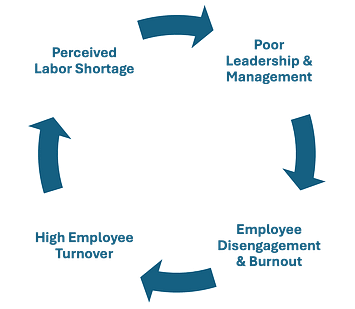
Avoided conversations create measurable consequences. Organizations experience lower productivity. Projects stall because key issues are never resolved. Valuable employees leave.
Many leaders will tell themselves those employees were lazy, weak, or disloyal. Yet the conflict cycle continues, causing confusion and more inaction. On the personal side, this avoidance can lead to stress, anxiety, resentment, burnout, and damaged relationships.
The conversation you avoid at work can affect your well-being at home, too. The conversation you avoid at home can affect your performance at work. Conflict rarely stays neatly contained. When we fail to address issues directly and respectfully, they have a tendency to show up elsewhere. Conversely, when we build and use our conflict resolution skills in one area, we tend to practice and benefit from them in others. Again, conflict rarely stays neatly contained, which can be good.
A Different Approach
You will be relived to know that difficult conversations do not require perfection. Remember how you used to script and practice conversations? They didn’t go as planned because you were delivering a monologue, not having a discussion that allowed the other person to ask the questions they needed to understand and accept the situation.
Difficult conversations require courage, preparation, curiosity, and a willingness to listen. Before engaging with the other person, make the Seven Choices from DIY Conflict Resolution. Then, ask yourself:
- What outcome am I hoping to achieve?
- What assumptions might I be making?
- What facts do I know?
- What do I still need to understand?
- How can I approach this conversation with both honesty and respect?
These questions help shift us away from blame and toward resolution. The goal is not to “win” the conversation. It is to create enough safety and understanding for meaningful dialogue to occur.

Join Us for DEI for REAL
If you’re looking to decrease conflict in your workplace, join me and Spectra Diversity CEO Chris Jones for our September “DEI for REAL” webinar on Conflict Mediation and Psychological Safety. Together, we’ll explore practical tools for:
- Navigating difficult conversations with confidence
- Building trust across differences
- Managing conflict before it escalates
- Creating environments where people feel safe enough to speak up and skilled enough to work through disagreements
Healthy organizations are not free from conflict. They are filled with people who know how to address conflict productively.
The question isn’t whether difficult conversations will arise. It is whether we’re willing and prepared to have them. That may be one of the most important investments we ever make in our businesses–and ourselves.