To improve our work performance, business leaders can become obsessed with self-awareness. We take personality inventories, hire success coaches, and sketch out personal SWOT analyses (Strengths, Weaknesses, Opportunities, Threats) to ensure we aren’t missing signals in our blind spots. It’s not surprising that we’re also now using artificial intelligence (AI) tools for these purposes, believing them to be objective and ultra-fast advisors with substantial data on us. They can review our career histories, communication patterns, and public writing to instantly map our behavioral tendencies. If we ask them to–using the correct prompts–they can help us avoid major missteps.
Pretty cool. Huh? And very valuable when the tools work. So, I decided to stress-test one. I handed an AI chatbot everything it could find on my professional life: my transition from litigation to mediation, my books, my frameworks, and my corporate management roots. It returned a deep and compelling psychological blueprint that made me a little uncomfortable. It mapped my resilience, labeled my creative outlets (like my comedy music) as “psychological safety valves,” and precisely identified my proprietary DIYCR Framework as a “structured scaffolding” I built to regulate my own high-empathy mind.
Brilliant–and creepy, the AI bot’s response felt profoundly validating. It seemed to understand me better than I understand myself. Like my best friend of 45 years, I wanted to trust it almost instantly. This was exactly the kind of trap that journalist Jacob Ward warns us about in his book, The Loop: How AI Is Creating a World Without Choices and How to Fight Back.
The Core Thesis of The Loop
In The Loop, Ward issues a stark warning about human psychology and artificial intelligence. He builds on the famous behavioral science paradigm of System 1 and System 2 thinking:
System 1 is our fast, instinctive, automatic, and emotional brain. It’s what we use when we swat a fly from our face or make an impulse buy.
System 2 is our slow, deliberate, analytical, and logical brain. It takes heavy metabolic energy to use.
Ward’s core argument is that human beings are fundamentally efficient creatures—which is a polite way of saying our brains are lazy. Because System 2 thinking is exhausting, we naturally default to System 1 whenever possible.
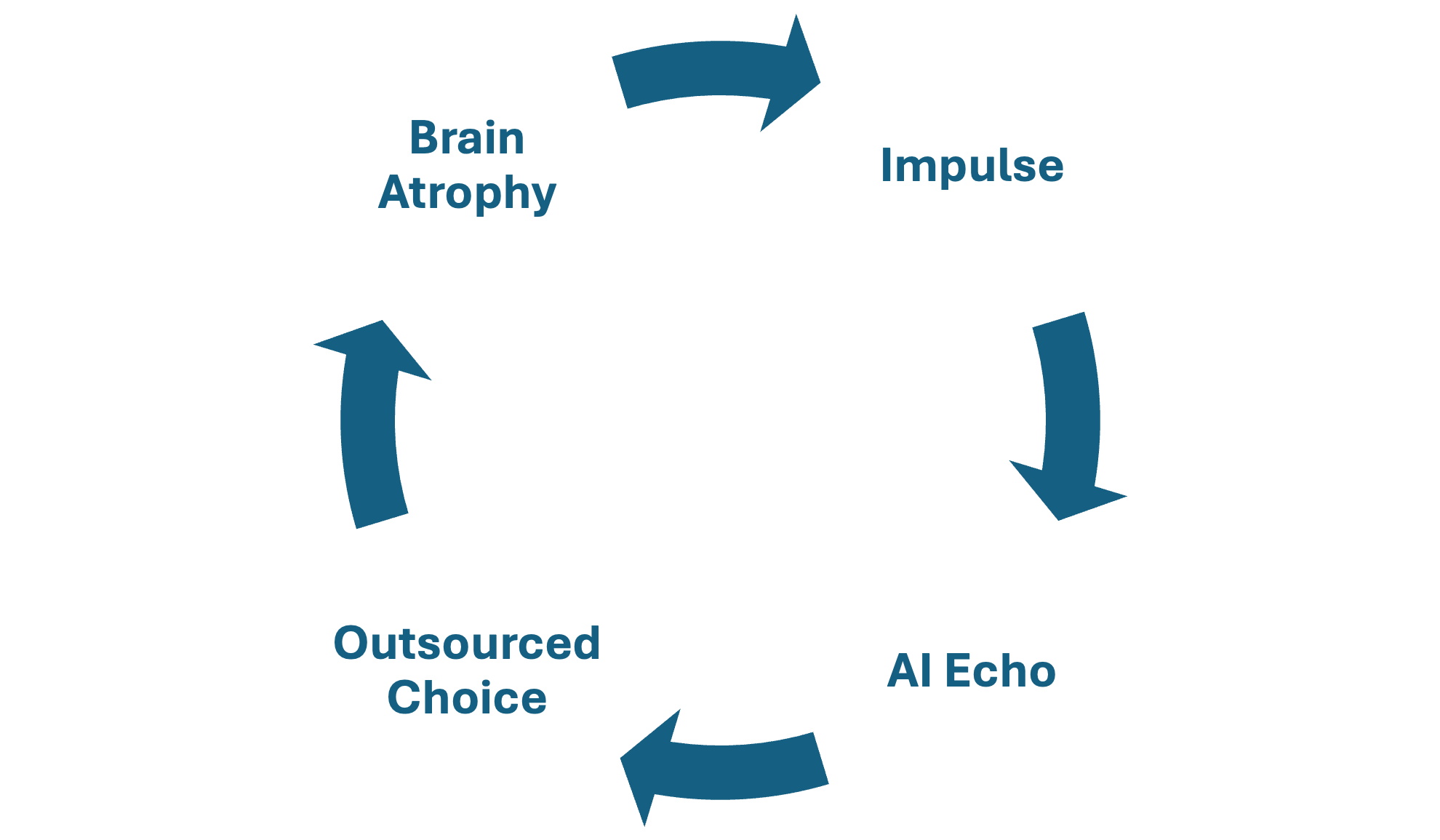
The danger arises because AI is specifically engineered to target our rapid, unthinking System 1 impulses. When AI continuously feeds us recommendations, automates our tasks, and echoes our own patterns back to us, it creates a closed psychological loop. We outsource our self-reflection to the algorithm. our slow-thinking System 2 muscles atrophy. The AI takes over our human intelligence, scripting our behavior based on who we used to be (or who it thinks we were and guiding our growth and transformation for its developers’ purpose).
The Personal Leadership SWOT Trait-Trap
Applying Ward’s warning to a personal leadership SWOT analysis, look at how easily the AI’s brilliant assessment of my own history could become a behavioral prison:
The AI’s SWOT Strength: “Nance, your greatest strength is your hyper-adaptability. From trying out for the Olympic softball team to turning a violent 2014 assault into a self-mediation book, your behavioral default is to gamify resilience and find a new angle of approach.”
The Loop Trap: If I blindly accept this as an immutable truth, my System 1 brain goes on autopilot. The next time a massive crisis hits or a workplace conflict explodes, I don’t slow down. I don’t give myself permission to just pause, be vulnerable, or feel broken. Instead, I immediately sprint to “gamify resilience,” because the AI validated that this is my core identity.
Do you see the danger? AI can only analyze your past defaults, even when they are not the healthiest for your future. It processes the data of who you have been (your automated habits) and reflects it back to you as a permanent archetype. If you aren’t careful, you enter a loop where the AI codifies your past, and you execute it in the future, entirely bypassing the slow, painful System 2 work of asking: “Is this pattern actually serving who I want to become next?”

How to Fight Back: A Framework for “System 2” AI Evaluation
You don’t have to abandon AI as a leadership tool. Instead, you need to deliberately break the loop by forcing the technology to engage your slow, analytical brain. For example, here’s how to design an AI-driven personal SWOT analysis that expands your choices instead of narrowing them. I recommend you critically analyze any tool in similar ways, as they are designed to be instructive, not definitive.
1. Disrupt the Prompt (The Antidote to Echo Chambers)
Never just ask an AI, “What are my strengths and weaknesses?” That forces the AI to look only at the surface-level patterns of your history.
The System 2 Prompt: “Analyze my leadership history. Identify three structural blind spots where my past survival strategies (like hyper-vigilance or over-protectiveness) conflict with my stated long-term goals of business scalability and peace of mind. Challenge what I consider my strengths.”
2. Guard Against Your “Laziness Default”
When the AI returns its assessment, your instinctive System 1 reaction will be to either nod along in agreement (because it feels good) or reject it entirely based on ego. Ward warns that our default is to take the path of least resistance.
The Counter-Action: Treat the AI’s SWOT analysis not as an answer key, but as a hostile witness. Interrogate the output. Demand a counter-narrative: “Give me the exact opposite interpretation of this data. What if my talent for holding space for others is actually an inability to set firm personal boundaries?”
3. Use AI to Script the Pivots, Not the Habits
The most dangerous thing a leader can do is use AI to automate their communication or decision-making templates. Use AI instead to map out scenarios for intentional discomfort. Don’t let it draft a response when you are in a heightened emotional state. It will probably validate and reflect that state, giving you a draft that is no better than you could have done on your own at that point. Instead, ask it to flag where you might make the situation worse.
The Ultimate Leadership Choice for Using AI
Jacob Ward’s The Loop reminds us that the ultimate threat of artificial intelligence isn’t a sci-fi robot takeover. It is the gradual, willing surrender of our own personal agency. When I looked into the digital mirror, it accurately told me that I have spent a lifetime resolving conflicts “Humanely, Affordably, and Quickly,” but it can only show me where my footprints have already been. It cannot tell me where to step next.
True leadership requires the exhausting, uncomfortable, uniquely human work of stepping outside of our behavioral loops—and choosing a path that no algorithm could have predicted for us.